
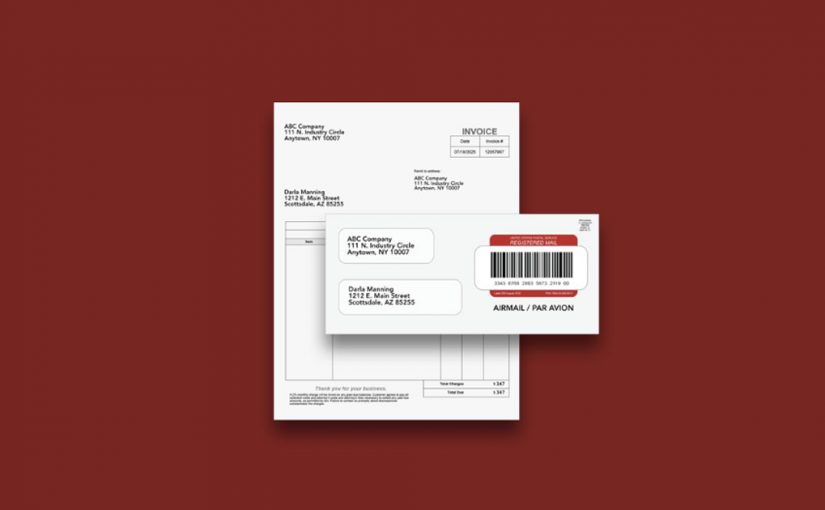
Can you send Certified Mail internationally? The short answer is no—Certified Mail online is a United States Postal Service (USPS) domestic service only. But that doesn’t mean you’re out of options.
If you manage legal, financial, or compliance-related communication and need documentation for international mail, understanding the difference between Certified Mail and Registered Mail is critical. The right service depends on where the letter is going and what level of proof you require.
Let’s clarify how international mail works and what to use instead of Certified Mail when sending documents abroad.
Why Certified Mail Is Domestic Only
Certified Mail is designed specifically for mail sent within the United States and its territories. It provides:
- Proof of mailing
- A tracking number
- The option for Return Receipt (signature confirmation, either a green card or Electronic Return Receipt)
According to USPS, Certified Mail is available only for domestic First-Class Mail and Priority Mail.
That means if you are trying to send a legal notice to Canada, a contract to Europe, or compliance documentation to Asia, Certified Mail online is not an available option.
This limitation often surprises organizations that rely heavily on Certified Mail for domestic communication.
So what’s the alternative?
What Is Registered Mail for International Documentation?
For international mail requiring enhanced documentation, USPS offers Registered Mail.
Registered Mail provides:
- Secure handling
- Tracking
- Documentation of processing
- Added protection for valuable or sensitive items
While Certified Mail online focuses on proof of mailing and optional signature confirmation within the United States, Registered Mail is positioned as a more security-focused option, particularly for certain international shipments.
However, it’s important to include a practical disclaimer:
USPS outlines how Registered Mail is designed to function, but real-world performance can vary—especially once mail leaves the United States and enters foreign postal systems. Transit times may be longer than expected, tracking updates can become inconsistent, and handling standards depend in part on the destination country’s postal infrastructure.
Because of this, Registered Mail should be used only when truly necessary. In many cases, it can move slower than other international services, and the visibility may not be as predictable as businesses assume. While it is marketed as highly secure, it is still subject to international processing variables outside of USPS control.
If your priority is documentation for a required international mailing, Registered Mail may be appropriate. But if timing, predictable tracking, or operational consistency are critical, it’s important to evaluate all available options carefully.
How to Send International Mail When Documentation Matters
If you’re using a print and mail service like LetterStream for domestic Certified Mail online, international needs require a slightly different workflow.
Start by asking:
- What country is the item going to?
- Is signature confirmation required?
- Is security or chain-of-custody documentation necessary?
- Is the content time-sensitive?
For some time-sensitive international documents, private carriers may also be considered, depending on requirements.
While Certified Mail online cannot be used internationally, your broader strategy for sending mail online should still focus on structure and documentation.
For domestic communication, Certified Mail online remains a widely used option when proof of mailing and tracking are required. For international communication, Registered Mail or other trackable international services provide the documentation layer.
Common International Use Cases
Organizations often encounter international mailing needs in scenarios such as:
- Legal correspondence involving foreign property owners
- International board members receiving official notices
- Contracts sent across borders
- Construction or development documentation
- Healthcare or insurance communication
In these cases, documentation still matters—but the service must match the geography.
Trying to use Certified Mail internationally simply isn’t an option under USPS rules. Knowing that upfront prevents delays and incorrect submissions.
A Practical Approach to International Mail
Mail still carries legal and operational consequences. That does not change when the destination changes.
But international mail requires realistic expectations.
If documentation is required and slower transit is acceptable, Registered Mail may work. If speed and tracking consistency are critical, evaluate other international carrier options carefully.
The most important step is understanding that Certified Mail online stops at U.S. borders—so plan accordingly.
To learn more about LetterStream or to sign up for a free account, click here.
LetterStream offers bulk printing and mailing services, allowing companies to send physical mail online. Whether it’s online Certified Mail, First-Class Mail, FedEx 2Day, or postcards, we give both small businesses and large corporations the time and freedom back to work on tasks that better serve the company. If you’re interested in creating a free account, you can do so here.